

Most people think developers who write more code simply work longer hours.
That used to be true.
But lately, something has changed, quietly, almost unnoticed.
Some of the most productive developers aren’t constantly online. They aren’t pushing commits every hour. They aren’t caught up in “hustle culture.”
Yet they are delivering projects faster, encountering fewer bugs, managing more complex responsibilities, and burning out less.
The secret isn’t working harder; it’s working smarter. AI coding tools are doing some of the heavy lifting. Not loudly, not publicly, but very intentionally helping developers focus on the work that truly matters.
In 2025, AI-powered code assistant adoption surged from 49% in January to 69% by October among engineering teams, while nearly half of companies now feature at least 50% AI-generated code in their workflows.
Let’s see how.
Table of Contents
AI Coding Tool Adoption Continues to Rise
The numbers tell the story first.
Data from Jellyfish shows that the use of AI code assistants climbed steadily—from just under half of developers at the start of the year to nearly seven out of ten by October. Usage peaked in late summer, right as new releases like Claude Opus 4.1 and major GPT-5 updates entered everyday development workflows.
That spike wasn’t accidental.
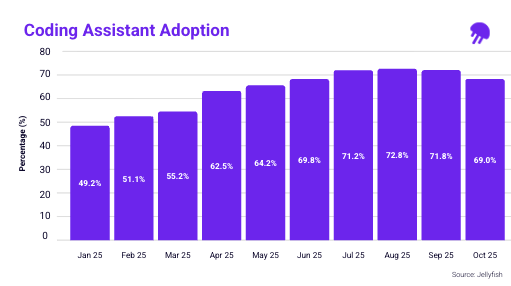
Developers are trusting AI for coding more than ever before. Over the past year, coding assistants have evolved from simple autocomplete tools into context-aware helpers. They understand projects, follow intent, and fit naturally into daily work. The result is faster execution and less friction across routine development tasks.
Adoption of AI-powered code review tools jumped sharply—from less than 15% early in the year to more than half of teams by October. This surge aligned with the release of Copilot Code Review. Today, teams rely on AI to flag vulnerabilities, suggest fixes, and improve overall code quality before issues reach production.
Some tools are clearly leading the way.
GitHub Copilot is still the most popular AI coding assistant, followed by Claude Code and Cursor. In code review, Copilot is the most popular tool, but Cursor Agent is become more popular. Retention tells an even better narrative. Almost nine out of 10 engineers still use Copilot or Cursor months after they first started using them. This shows that these tools are no longer experiments; they are already essential aspects of modern AI-assisted development.
This signal is clear for engineering leaders.
The 2025 DORA research says that AI in software development doesn’t just make things go faster; it also magnifies what already exists. As AI becomes more common, it’s important to carefully integrate it and create skills.
How AI Is Transforming the Way Developers Write Code
AI isn’t just a shiny tool on a developer’s desk. It’s quietly reshaping how coding work gets done. Developers are spending less time on repetitive tasks, making fewer mistakes, and focusing more on meaningful problem-solving.
Here are seven ways AI for coding is changing everyday development—and why teams are seeing real results.
-
Cutting Through the Boilerplate
It’s tiring to have to write the same setup code, APIs, and templates over and over. AI coding tools do this on their own.
GitHub Copilot and other tools can make snippets, suggest auto-completions, and even write documentation. That means you can save 30% to 75% of the time you spend on repetitive tasks and speed up development by up to 50% for typical patterns. Developers stop writing boilerplate code and start fixing genuine issues.
Less repetition also means fewer mistakes, cleaner code, and more time to think about bigger things.
-
Debugging Without the Headaches
Debugging can take a lot of time and energy quickly. AI-powered code assistants go through code in real time, find possible mistakes, and offer solutions before problems get worse.
People that use Copilot say they have to make 16.6% fewer changes and spend up to 70% less time fixing bugs. This not only speeds things up, but it also lowers stress and helps developers, especially junior ones, learn faster by figuring out why things go wrong.
-
Getting More Done in Less Time
AI doesn’t just save minutes; it changes output.
Teams using Copilot complete up to 126% more projects per week, while broader adoption shows gains between 21% and 78%. High-adoption teams spend 33–36% less time on routine development work.
By offloading predictable tasks, AI-assisted development frees developers to focus on design, architecture, and innovation—the work that actually moves products forward.
-
Better Code, Less Rework
Faster doesn’t mean sloppy. In fact, AI improves code quality. Around 59% of developers report better code when using AI, rising to 81% when it’s integrated into reviews.
Test coverage goes up 12-18%, and maintainable code improves by 10%. Early error detection and pattern suggestions mean less rework, fewer bugs in production, and more reliable software.
Teams spend less time fixing problems and more time building solutions that last.
-
Rapid Prototyping That Actually Works
What once took weeks now takes days. Prompt-based UI generation tools like V0 enable teams to iterate up to five times faster. Smaller companies report 50% faster testing and prototyping cycles.
Rapid experimentation encourages creativity, faster feedback, and quicker launches—without exhausting teams.
-
Smoother Team Collaboration
AI also improves how teams work together. Virtual pair programming, automated checks, and intelligent suggestions reduce merge conflicts by up to 60% and speed up onboarding.
With AI-powered coding tools handling routine checks, teams can focus on collaboration, communication, and decision-making.
-
Adoption Is Growing Fast
AI is no longer a choice. About 87% of developers use AI tools, 65% use them every week, and about 41% of code around the world is at least partly made by AI. Full integration is still only about 30%, but more people are starting to use it.
Teams who adopt AI early have a clear edge: they can deliver faster, write better code, and avoid burnout.
It’s not only about making things easier to use AI for coding every day. It helps developers get less done that they have to do again and over again, work together better, and focus on the most important tasks. Instead of spending hours on boilerplate or debugging, teams may spend that time coming up with new ideas, solving problems, and thinking strategically, all while keeping the code quality high.
What This Shift Means for the Future of Development
Over the next few years, AI will stop feeling new. It will simply become part of how software is built. Manual-only workflows will feel outdated as AI in software development becomes the norm.
Developers who avoid AI won’t vanish—but they will work harder for the same results. Meanwhile, AI-assisted developers will appear calm, reliable, and consistent, delivering steady results with less friction.
The biggest change isn’t intelligence—it’s selectivity.
AI helps developers decide what deserves human focus and what can be automated safely. When low-value work disappears, mental energy is protected—and that leads to better systems and better outcomes.
That quiet shift is what truly changes everything.
The Road Ahead!
Using AI doesn’t require announcements or automating everything overnight.
It starts with one honest question: Should a human really be doing this?
If the answer is no, AI probably already can.
Developers who understand this don’t chase every new tool. They quietly remove friction from their workflow and end up working less on busy tasks while delivering more of what truly matters.
For teams and leaders, the next step is building the right mix of skills, support, and mindset to work effectively with AI. That’s where the real advantage begins.
Organizations partnering with experienced talent providers like Zeero tech talent solutions are better positioned to adapt, upskill teams, and build development workflows that scale with AI, without sacrificing quality or focus.
If your team is exploring AI-driven development or planning the next phase of technical growth, now is the time to invest in the right people and processes. The future of development is already here, quietly reshaping how great software gets built.