
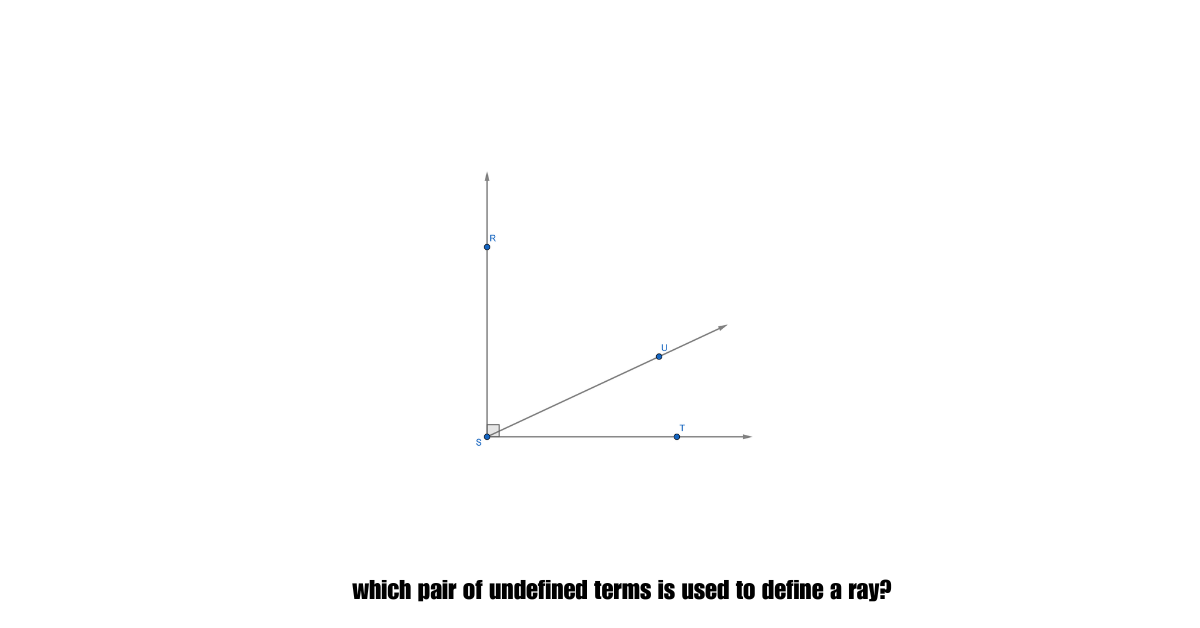
Geometry often starts with a few simple ideas that help explain more complex shapes and figures. One of the most common questions students ask is: which pair of undefined terms is used to define a ray?
If you’ve ever studied basic geometry, you might have heard about points, lines, and planes—the three fundamental building blocks of geometric concepts. From these simple ideas, mathematicians define many other figures, including rays, segments, and angles.
In this article, we’ll clearly explain which pair of undefined terms is used to define a ray, why these terms matter in geometry, and how they help us understand rays with simple examples.
Understanding Undefined Terms in Geometry
Before we answer the main question, it’s important to understand what undefined terms are.
In geometry, undefined terms are basic concepts that are not formally defined using other mathematical terms. Instead, they are accepted as fundamental ideas that help define everything else.
The three main undefined terms are:
-
Point
-
Line
-
Plane
These concepts form the foundation of Euclidean geometry.
1. Point
A point represents an exact location in space.
It has no length, width, or height.
Example:
Points are usually labeled with capital letters such as A, B, or C.
2. Line
A line is a straight path that extends infinitely in both directions.
Key characteristics:
-
Has no thickness
-
Contains infinitely many points
-
Extends forever
3. Plane
A plane is a flat surface that extends infinitely in all directions.
Examples include:
-
A tabletop surface
-
A sheet of paper (conceptually)
Which Pair of Undefined Terms Is Used to Define a Ray?
The correct answer to the question “which pair of undefined terms is used to define a ray?” is:
Point and Line
A ray is defined using these two fundamental concepts.
Definition of a Ray
A ray is a part of a line that:
-
Starts at a single point (endpoint)
-
Extends infinitely in one direction
In other words, a ray begins at a point and continues along a line forever in one direction.
Visualizing a Ray
Think of a flashlight beam.
-
The flashlight itself represents the starting point
-
The light beam traveling forward represents the ray
Mathematically, a ray is written using two points.
Example:
Ray AB (→AB)
Here:
-
Point A is the endpoint
-
Point B shows the direction the ray extends
Key Characteristics of a Ray
A ray has several important properties:
-
It has one endpoint
-
It extends infinitely in one direction
-
It is part of a line
-
It is represented using two points
Summary of Properties
| Property | Description |
|---|---|
| Endpoint | Starting point of the ray |
| Direction | Extends infinitely from the endpoint |
| Representation | Named using two points |
| Relation | Part of a line |
Difference Between Ray, Line, and Line Segment
Many students confuse rays, lines, and segments. Here’s a simple comparison.
| Figure | Endpoints | Direction |
|---|---|---|
| Line | None | Infinite both directions |
| Ray | One | Infinite in one direction |
| Line Segment | Two | Finite length |
Example:
-
Line: ↔AB
-
Ray: →AB
-
Segment: AB
Understanding this difference makes geometry concepts much easier.
Real-Life Examples of Rays
Rays are not just abstract mathematical ideas. They appear in many real-world situations.
Examples include:
-
Sunlight rays
-
Laser beams
-
Flashlight beams
-
Projector light
Each of these starts at a source point and moves outward in one direction, just like a geometric ray.
Why Undefined Terms Matter in Geometry
You might wonder why mathematicians rely on undefined terms at all.
The reason is simple: every logical system needs basic starting ideas.
Undefined terms allow mathematicians to:
-
Build consistent definitions
-
Develop geometric rules
-
Create theorems and proofs
Without points and lines, defining objects like rays, segments, angles, and polygons would be impossible.
Common Mistakes Students Make
When learning which pair of undefined terms is used to define a ray, students sometimes confuse the concepts.
Here are common mistakes:
1. Thinking a ray has two endpoints
That actually describes a line segment.
2. Confusing a line with a ray
A line extends in both directions, while a ray extends in one.
3. Forgetting the endpoint
Every ray must start from a specific point.
FAQs
What pair of undefined terms defines a ray?
The pair of undefined terms used to define a ray is point and line. A ray begins at a point and extends infinitely along a line in one direction.
What are the three undefined terms in geometry?
The three undefined terms are:
-
Point
-
Line
-
Plane
These serve as the foundation of geometric definitions.
How is a ray represented in geometry?
A ray is written using two points. The first point represents the endpoint, while the second point indicates the direction of the ray.
Example: Ray AB
Is a ray infinite?
Yes, a ray extends infinitely in one direction, but it has one fixed endpoint.
What is the difference between a ray and a line?
-
Line: Infinite in both directions
-
Ray: Infinite in one direction
-
Segment: Finite with two endpoints
Conclusion
So, which pair of undefined terms is used to define a ray? The answer is point and line.
A ray begins at a point and extends infinitely along a line in one direction. This simple idea plays a crucial role in understanding many other geometric concepts, including angles, shapes, and coordinate geometry.
Once you grasp how undefined terms form the foundation of geometry, it becomes much easier to understand how mathematicians build complex geometric systems from a few simple ideas.
If you’re learning geometry, mastering these basics will make advanced topics far easier to understand.